

“Autistic-like creatures, capable only of the most simple behaviors compatible with physiological survival, emerge out of this process. Their spirit has died … They are no longer capable of executing the more complex behaviors compatible with species survival.”
Dr. John B. Calhoun
Dr. John B. Calhoun was a pioneer in the study of animal behavior during the 1960s, a period of significant scientific advancement. He had already carried out a number of studies to examine how population density affected behavior since he was interested in the social dynamics of rodents. His most well-known experiment, called the Universe 25, became a cautionary tale about the dangers of overcrowding and social breakdown.

Universe 25 was named after the 25th colony established by John B. Calhoun in his series of rodent population experiments. Calhoun dubbed each of his colonies “Universe” followed by a number, beginning with Universe 1 in the early 1950s.
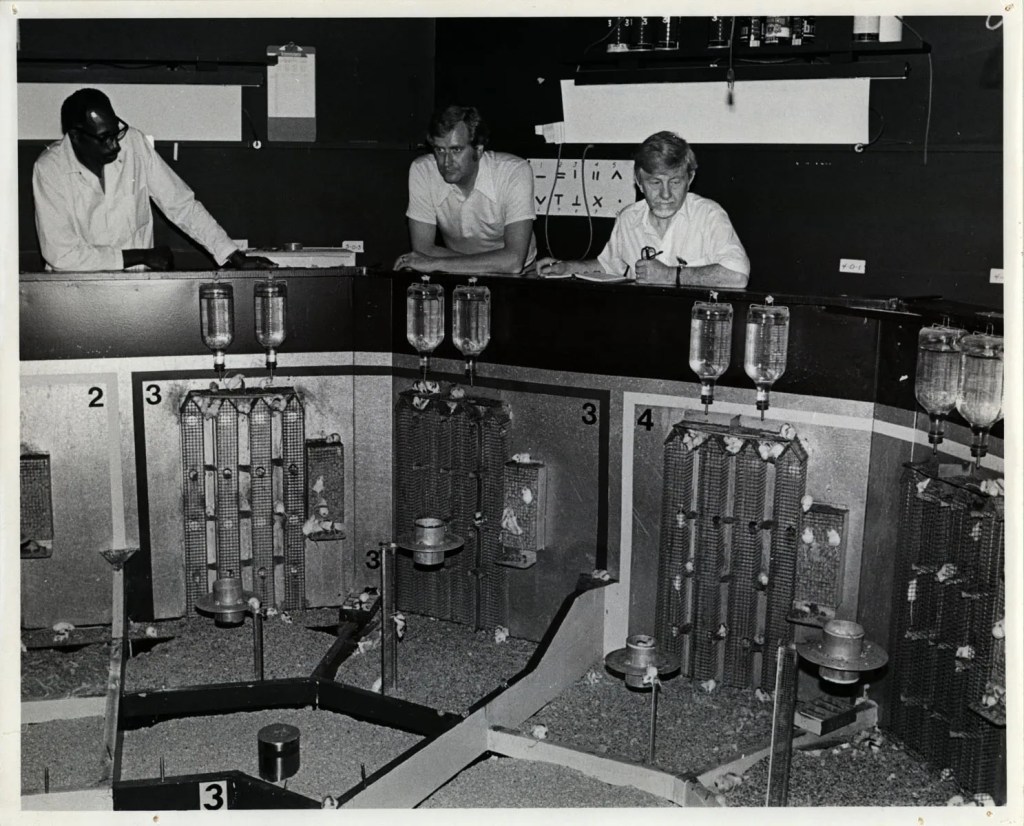
The experiment was intended to to create an ideal environment in which mice could live and reproduce without being threatened by outside forces. The experiment was carried out in a 101-inch square box with high walls and no exits. Each of the four portions of the enclosure has its own food and water source. There were also nesting spaces and facilities for the mice to congregate and play.
Everything went swimmingly at first. The mice were flourishing, and their population was steadily increasing. However, as the population grew, things began to alter. The mice began to act strangely, and social order began to crumble.
There was an emergence of a group of aggressive male mice, which were termed the “beautiful ones.” These mice spent the majority of their time either fighting or grooming other male mice. They had no desire to reproduce or raise their children. As a result, they eventually burdened the rest of society.
Meanwhile, the female mice were struggling to care for their young. Many of them neglected or even killed their children. As a result, population declined and the number of mice in the enclosure started to decrease.
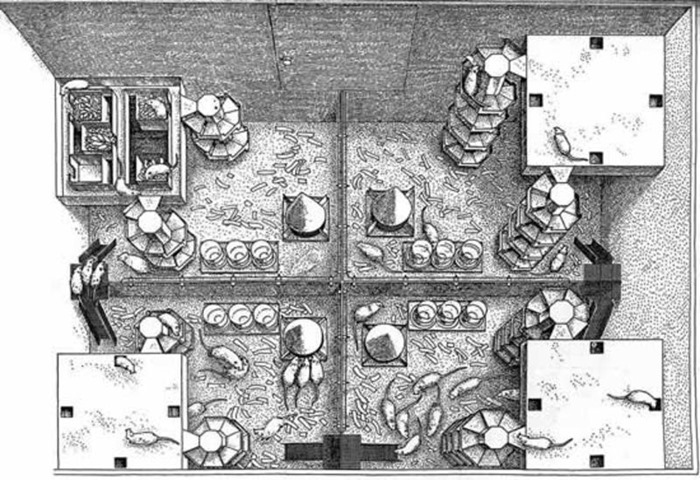
The mice also began to divide themselves into various social groups, according to the researchers. The dominant males and females concentrated in the center, while the weaker and more obedient mice congregated on the outskirts. This exacerbated social isolation and dysfunction.
The mice were more hostile and agitated, and the population began to exhibit unusual behaviors. Some mice grew lively, while others became apathetic and lost interest in their surroundings. The population of Universe 25 eventually collapsed after 600 days.
What can we take away from Universe 25? Even in a seemingly perfect environment, the experiment highlighted the dangers of overpopulation and isolation. It’s a cautionary tale about the value of connections with others and the consequences of ignoring our fellow species’ basic needs.
“We may well be creating our own utopia, only to find it a hell,”
– Dr. Calhoun.
Other similar experiments:
Mouse Utopia: In the 1960s, John B. Calhoun conducted a similar experiment on mice, called Mouse Utopia. The study involved placing mice in a high-density environment with unlimited resources, and observing the resulting social dynamics. Like Universe 25, the experiment found that the mice exhibited abnormal social behaviors, such as violence and withdrawal.
The Japanese Quail Experiments: Conducted by biologists David Blanchard and John Rowan in the 1980s, the Japanese Quail experiments studied the effects of overcrowding on social behavior and reproductive success in quail populations. The results showed that overpopulated quail populations exhibited increased aggression, decreased courtship behavior, and reduced reproductive success.
The Norway Rat Studies: Conducted by ecologist John Krebs in the 1970s, the Norway Rat studies investigated the effects of crowding on behavior and reproduction in wild rat populations. The results showed that overpopulated rat populations exhibited increased aggression, decreased fertility, and reduced survival rates.
References
Sarraf, Matthew Alexandar (2017). Of Mice and Men: Empirical Support for the Population-Based Social Epistasis Amplification Model (a Comment on). ENeuro 4.5 .
Blanchard, D. C., & Rowan, J. D. (1982). Responses of Japanese quail to chronic overcrowding. Applied Animal Ethology, 9(2-3), 181-188.
Calhoun, J. B. (1962). The ecology and sociology of the Norway rat. US Department of Health, Education, and Welfare.
 Designed by CKB
Leave a comment