I have been thinking about how quickly the mind can turn one bad thing into the only thing that matters.
You can have a perfectly ordinary day—maybe even a good one—and then one uncomfortable conversation happens. Someone says something that bothers you. You make a mistake. Something doesn’t go according to plan. And suddenly, that becomes the headline of the entire day.
The ten things that went right quietly disappear into the background.
The one thing that went wrong gets a chair, a cup of tea, and apparently permission to stay for the evening.
I used to think this was simply a personality trait. Maybe some people are naturally optimistic and others are pessimistic. Maybe some of us are just more prone to overthinking. But the more I think about it, the more I realize that our minds are not exactly neutral observers of our lives. They have habits. They learn patterns. And sometimes those patterns are very good at keeping our attention on what feels threatening, uncomfortable, embarrassing, or unresolved.
There is actually a name for part of this: negativity bias. We tend to give negative experiences more psychological weight than equally positive ones. It makes sense when you think about what the brain was originally designed to do. Remembering the thing that nearly killed you was probably more useful for survival than remembering the particularly beautiful sunset you saw that afternoon.
The problem is that most of us aren’t currently being chased through the forest.
Our threats are different now. An awkward email. Someone’s opinion of us. A plan falling apart. A mistake at work. A relationship changing. Uncertainty about the future. And yet the mind can grab onto these things with remarkable determination. Sometimes it goes beyond simply noticing them. We begin rehearsing them.
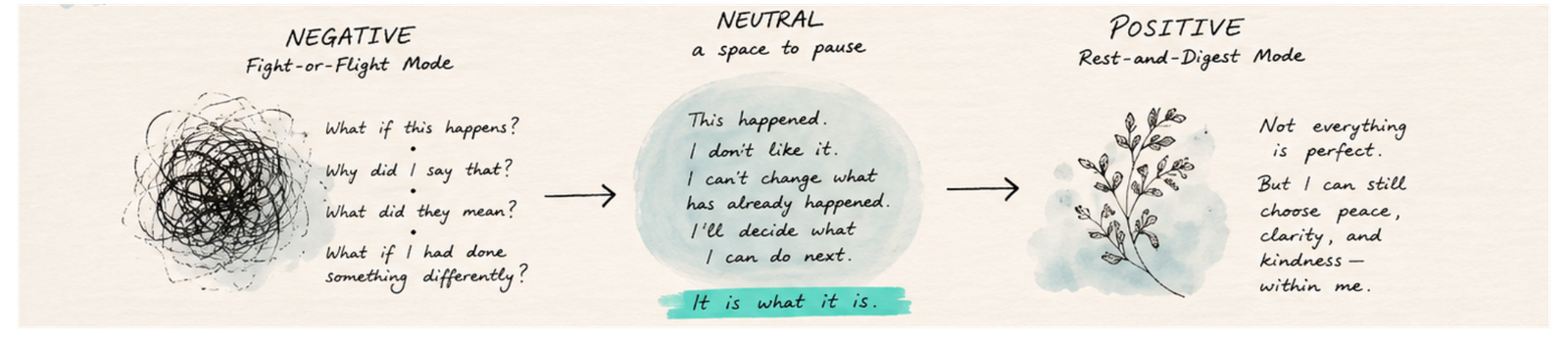
And before we know it, the original event has happened once in reality and another fifty times inside our heads.
Maybe that is the part worth noticing. Not every thought needs to be solved, followed, or believed. Sometimes the first step is simply catching ourselves in the middle of the replay and asking: is this still happening, or is my mind keeping it alive?
I’m still figuring out what we do after we notice it. But perhaps noticing is a good place to begin.
More on that in Part Two. ♡
Your first thought doesn’t have to be your final one. ♡
A thought can arrive before you have had any say in it. Fear can speak first. Doubt can speak first. The worst-case scenario can be surprisingly loud.
You don’t have to force those thoughts into something wonderfully positive. Sometimes you can simply meet them somewhere quieter.
“This happened. I can pause. I can choose what I do next.”
Maybe that little pause is enough for today.
CKB ♡